Faces of Wisconsin: Harry Houdini
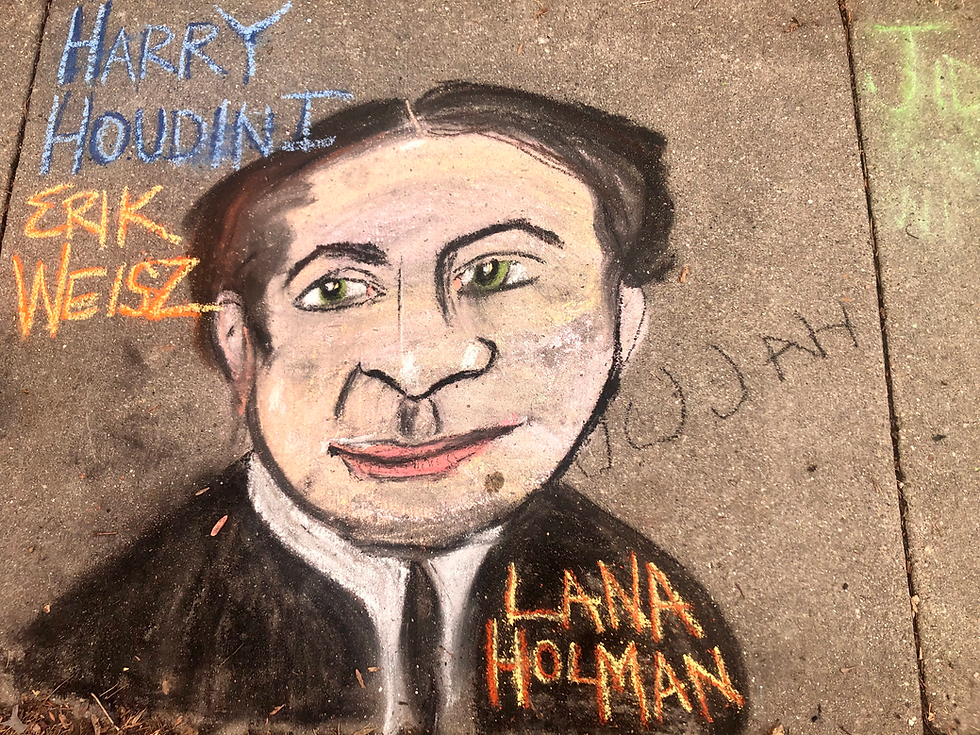
My first memory of learning about today's subject, Escape Artist and Illusionist Harry Houdini, was in hearing the cautionary tale of his death. The story feels like something out of Greek tragedy, the showman who routinely took punches to the abdomen as a feat of strength killed by punches from a fan when caught unprepared. The purpose of the story was unclear to me, perhaps a warning about horseplay, or maybe just hubris? 30-odd years later, he remains a mythical figure, a name that represents escape like Einstein means genius. And like Einstein, the true story of the person is far more interesting than the myth.
Harry Houdini was born Erik Weisz in 1874 in Budapest, Hungary. He was one of seven children born to Rabbi Mayer Sámuel Weisz and Cecília Steiner. The family immigrated to Appleton, WI in 1878, where his father became the Rabbi of Zion Reform Jewish Congregation. They moved to Milwaukee in 1882 when his father lost his position in Appleton. He was blessed with excellent physical stamina and agility from a young age, already working as a trapeze artist at 9 years old. He eventually found his way to vaudeville where he first did card magic and then discovered a talent for escapes. After making a name through a number of dazzling handcuff escapes, he became known as "The Handcuff King" and performed all over Europe. Back in the US he expanded his repertoire to include many of forms of confinement such as jail cells, and his famous "Milk Can Escape" in which he would escape from an oversized milk can filled with water and sealed. His talent eventually lead him to become the highest-paid performer in American vaudeville.
Houdini was active in the magic community. He was President of the Society of American Magicians from 1917 until his death in 1926. Membership was greatly expanded under his leadership, as he worked to realize his vision of a strong national magician network of both amateurs and professionals. He also fought against copycats and duplicators who stole routines from other magicians. He even performed his "Water Torture Cell" escape as a one-act play called "Houdini Upside Down" for an audience of one so that he could copyright the performance and create strong protections should someone try to replicate it.
He also carried on a proud tradition of stage magicians: the debunking of psychics and mediums. Using his knowledge of the techniques magicians use for distraction and concealment, he was able to reveal a number of frauds that had stumped other researchers. He also joined a group offering a cash prize through the publication Scientific American to anyone who could prove their abilities. The prize was never collected.
Houdini died at 52 of peritonitis caused by acute appendicitis after the infamous stomach injury prior to a show in Detroit. His grave at Machpelah Cemetery in Glendale, Queens was maintained for many years by payments from the Society of American Magicians to whom he willed a large sum of money, but eventually a dispute with the cemetery lead to it falling into disrepair. Today the Houdini Gravesite Restoration Committee is looking to raise enough funds to restore to the iconic status it deserves.


Comments